
The Real Value of Fractional Support Isn't What You Think
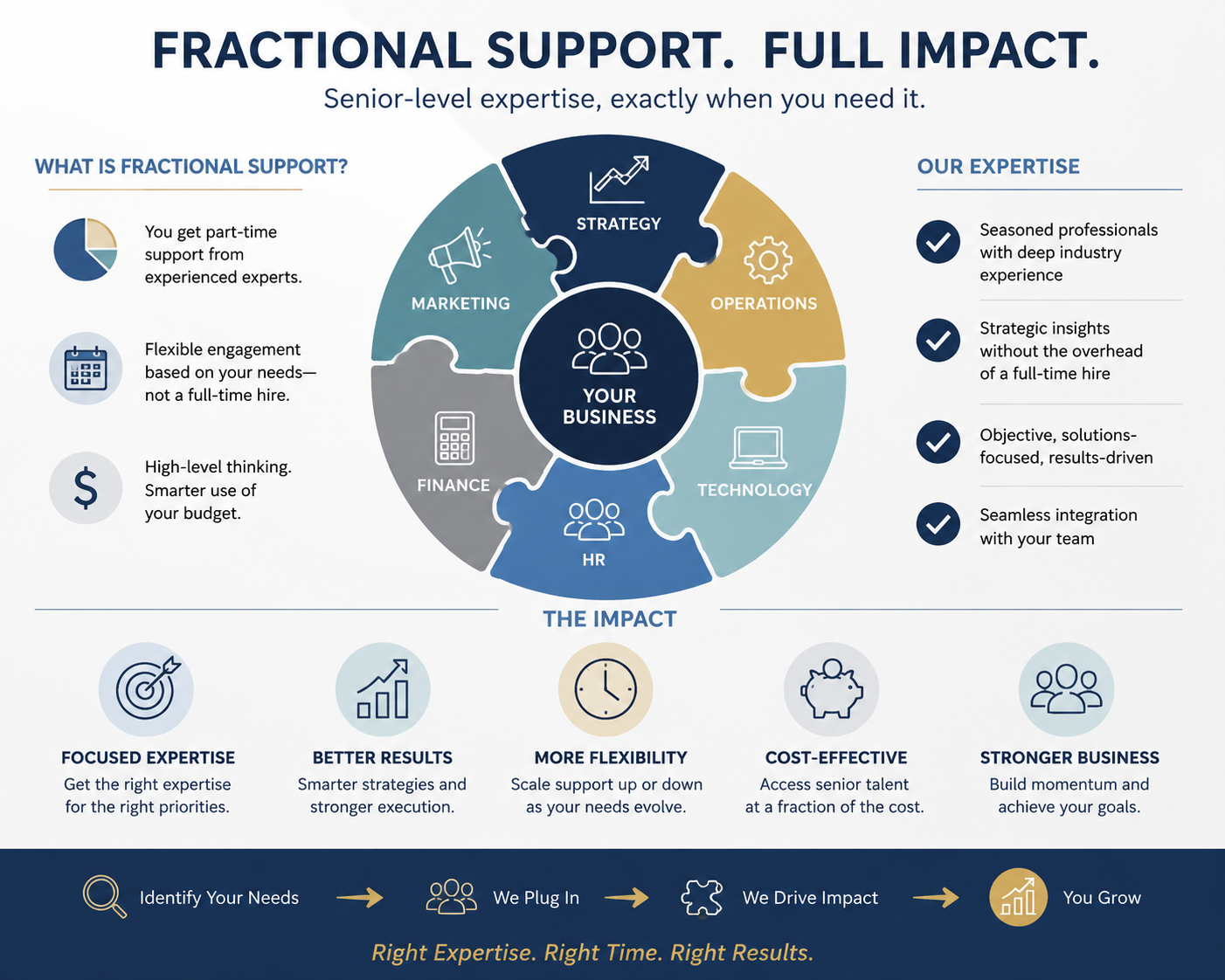
When most business leaders consider fractional support, they're usually focused on one thing: getting work off their plate.
And that's certainly part of the value.
Fractional accounting support helps manage financial operations. Fractional HR support helps navigate people challenges. Fractional recruiters help identify and attract talent. Fractional administrative professionals help keep the business moving.
But one of the most overlooked benefits of fractional support has nothing to do with task completion.
It's perspective.
The best fractional professionals don't just bring capacity. They bring experience, expertise, and exposure to challenges that many growing businesses encounter for the first time. And that perspective can be incredibly valuable.
At Sourced., we've spent a decade helping growing businesses access fractional Accounting, HR, Talent Acquisition, and Administrative Support. During that time, we've worked alongside hundreds of business leaders across a wide range of industries, growth stages, and organizational structures.
One of the things we've learned is that the best fractional relationships rarely succeed because of the tasks being completed.
They succeed because of the expertise, perspective, and experience being brought to the table.
Access to Talent You May Not Be Ready to Hire Full-Time
One of the biggest advantages of fractional support is access.
Growing businesses often need expertise long before they need a full-time employee. A company may need a seasoned HR professional but not forty hours a week of HR support. They may need an experienced accountant but not a full accounting department. They may need recruiting expertise but only when hiring demands arise. The challenge is that hiring experienced professionals internally can be expensive, especially when the workload doesn't yet justify a full-time role.
Fractional support bridges that gap.
Instead of waiting until the need becomes overwhelming, leaders gain access to experienced professionals exactly when they need them. The result is often stronger execution, better processes, and higher-quality support without the overhead of a full-time hire.
Fractional Professionals Bring a Different Kind of Experience
One of the most underappreciated aspects of the fractional model is the breadth of experience it creates.
Most employees gain experience within one company at a time. Their perspective is shaped by a single culture, leadership team, and set of processes.
Fractional professionals operate differently.
Because they work with multiple organizations, industries, and leadership teams, they are exposed to a much wider range of challenges and solutions. They see what works, what doesn't, and where businesses commonly get stuck. Over time, that exposure creates a unique level of expertise. When a challenge arises, there's a good chance they've encountered something similar before. Not because they've worked inside your business, but because they've worked alongside many businesses facing similar issues.
Better Exposure Leads to Better Ideas
Business leaders don't always need someone to create a brand-new solution. Often, they need someone who can bring perspective.
One company may have solved a hiring challenge in a way another company hasn't considered. One leadership team may have implemented a process that dramatically improved efficiency. One business may have already navigated a challenge another organization is just beginning to face.
Fractional professionals have the advantage of seeing these patterns develop across multiple organizations.
The value isn't copying another company's approach. The value is bringing ideas, insights, and lessons learned into the conversation so leaders can make more informed decisions.
Why Fractional Support Helps Leaders Think Differently
This is where the conversation becomes interesting.
The best fractional partners don't simply complete tasks and disappear.
Over time, they become trusted resources because they bring a broader perspective to the table. They've seen what happens when companies grow too quickly. They've seen where systems break down. They've seen hiring mistakes, operational bottlenecks, compliance issues, and scaling challenges.
That experience often helps leaders evaluate situations differently. Not because the fractional professional knows everything.
But because they've seen enough patterns to recognize risks, opportunities, and solutions that may not be immediately obvious.
More Than Additional Capacity
Many leaders initially engage fractional support because they need help getting more done. And they usually do get more done. Tasks move faster. Projects gain momentum. Operational burdens decrease. But the longer the relationship continues, the more leaders begin to realize they're gaining something else.
They're gaining access to professionals who bring experience from dozens—or sometimes hundreds—of organizations. They're gaining access to knowledge that would take years to accumulate internally. And they're gaining access to people who can help them see around corners because they've watched other businesses travel similar paths before.
That's difficult to quantify.
But it's often where the greatest value exists.
The Bottom Line
The value of fractional support doesn’t help leaders do more. It gives them access to expertise they may not otherwise have.
Access to experienced professionals. Access to broader perspectives. Access to lessons learned across multiple organizations. Access to talent long before they're ready to hire it full-time.
The best fractional partners bring knowledge, experience, and perspective that help businesses grow faster, avoid common mistakes, and make better decisions along the way. And for many growing organizations, that may be the most valuable contribution of all.
At Sourced., we've seen this firsthand. Businesses often come to us looking for help with accounting, HR, recruiting, or administrative support. What they frequently discover is that the value extends far beyond task completion. They gain access to professionals who have seen similar challenges before, helped other organizations navigate growth, and bring a level of expertise that would be difficult to build internally.
That's the true power of the fractional model.
It's not just about getting work done.
It's about gaining access to the people, experience, and perspective that help your business move forward with confidence.