
How Class Tracking Turns Financial Statements Into Decision-Making Tools
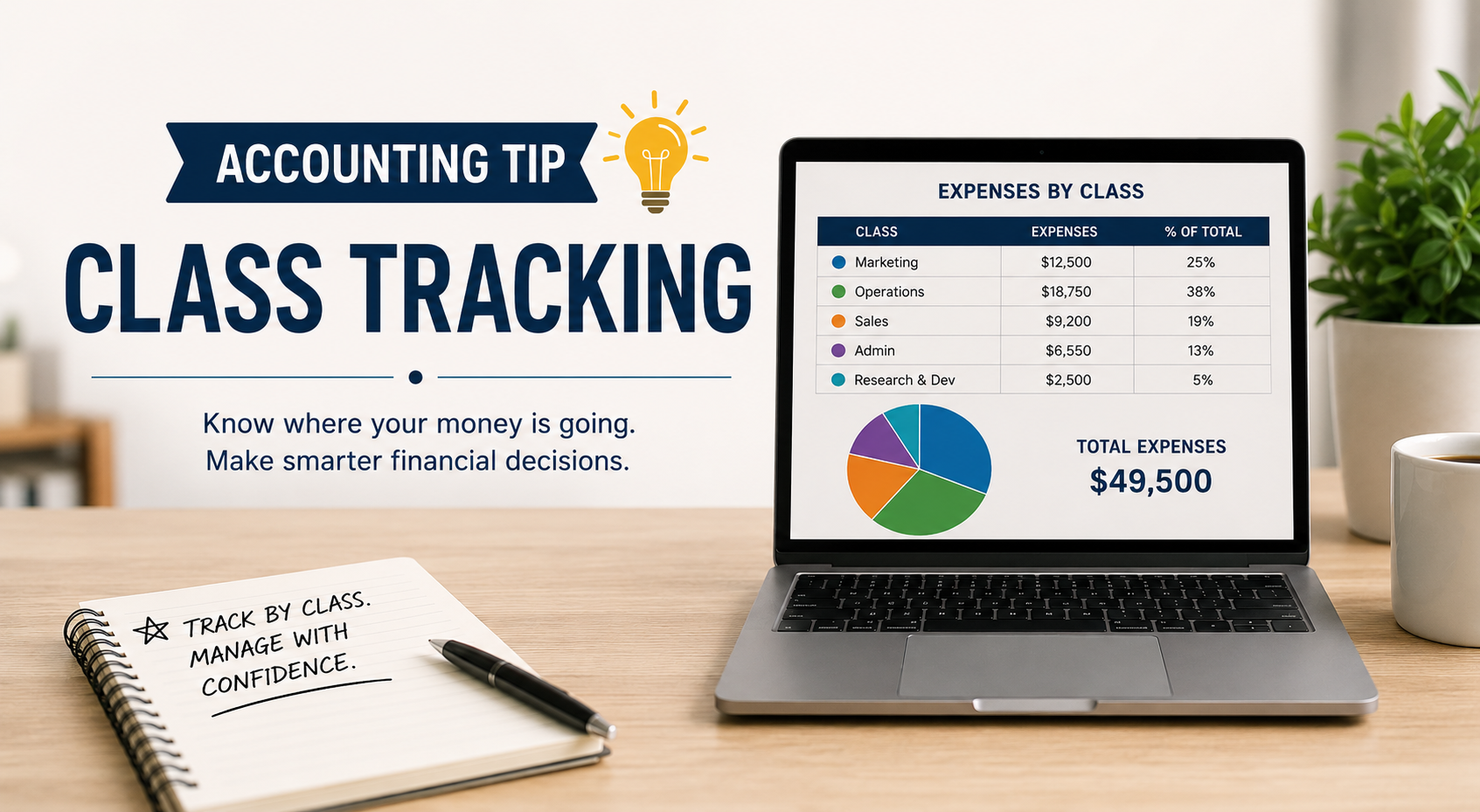
Most business owners know whether their company made money. Far fewer know where they made money.
That's where class tracking comes in.
At Sourced., class tracking is one of the most common recommendations we make to clients who want greater visibility into their business. It allows leaders to move beyond simply reviewing financial statements and start understanding what's actually driving profitability.
Before we discuss why class tracking is so valuable, it's important to understand the difference between categorizing and classifying transactions.
Understanding the Difference Between Categories and Classes
Before class tracking can be useful, it's important to understand that categories and classes serve two completely different purposes in your accounting system.
Every transaction should be assigned to an account category. Categories are the foundation of your financial statements and determine how transactions appear on your Profit & Loss statement or Balance Sheet.
For example, a transaction might be categorized as:
Payroll Expense
Rent Expense
Office Supplies
Marketing Expense
Revenue
These categories tell you the type of transaction that occurred.
Class tracking does not replace categorization. Instead, it adds a second layer of information. Using class tracking, that same payroll expense could also be assigned to:
Maintenance Division
Installation Division
Downtown Location
North Region
Commercial Services
In other words, the category tells you what the transaction was, while the class tells you which part of the business it relates to.
A payroll expense is still a payroll expense. Class tracking simply allows you to see where that payroll expense belongs within the organization.
This additional layer of reporting is what makes class tracking so valuable. It allows you to analyze financial performance by department, location, service line, project, or other meaningful segments of the business rather than only viewing company-wide totals.
Why Class Tracking Matters
Without class tracking, most financial statements tell you how the business performed as a whole. You can see total revenue, total expenses, and overall profitability. While that information is important, it often leaves business leaders with unanswered questions.
A company may generate strong profits overall while one department consistently underperforms. A service business may offer several different services, but leadership may not know which service lines are generating the strongest margins. A business operating in multiple locations may know the company is profitable, but not whether every location is contributing equally to that success.
Traditional financial statements typically answer the question: Did the company make money?
Class tracking helps answer a different question: Where did the company make money?
That distinction may seem small, but it can significantly change the way leaders make decisions.
A Simple Example
Imagine you own a landscaping company that provides two primary services: landscape maintenance and landscape installation.
Without class tracking, you might know the company generated $2 million in revenue and earned a healthy profit. That's useful information, but it only tells part of the story.
What if one service line is responsible for most of the profit?
What if one division generates significantly higher margins than the other?
What if one area of the business requires substantially more resources to produce the same revenue?
Without class tracking, those answers can be difficult to find.
With class tracking, you can generate separate financial reports for each division. You may discover that maintenance generates consistent recurring revenue and strong margins, while installation produces higher revenue but lower profitability.
Suddenly, you're no longer making decisions based on assumptions. You're making decisions based on data.
Better Information Leads to Better Decisions
One of the primary reasons we recommend class tracking is because it creates visibility.
When business leaders can clearly see how different parts of the organization are performing, they can make decisions with greater confidence. For example, a company may discover that one service line consistently generates higher margins than the others. Another may find that one location is significantly outperforming the rest of the organization. Others may identify departments that are consuming resources without generating an appropriate return.
Without class tracking, these trends can remain hidden inside consolidated financial statements. With class tracking, leaders gain access to information that helps them make more informed decisions about hiring, pricing, marketing investments, expansion plans, and resource allocation.
The goal is to create better visibility.
Not Every Business Needs a Complex Class Structure
One of the most common mistakes we see is overcomplicating class tracking. Once business leaders understand the value of class reporting, there can be a temptation to track everything. Departments become classes. Locations become classes. Projects become classes. Service lines become classes.
While all of those may be appropriate in certain situations, more information is not always better information.
The most effective class structures are designed around the decisions leadership is trying to make.
If leadership wants to understand profitability by service line, service-line classes may make sense. If location performance is most important, locations may be the better structure. If project profitability is the goal, projects may become the appropriate class.
No one wants more accounting work. Instead, the goal is to create meaningful reporting that helps leaders better understand their business.
The Bottom Line
Most business owners know whether they made money. The best business leaders know where they made money.
Class tracking provides visibility that traditional financial statements often can't.
By adding context to your transactions, class tracking helps you understand which departments, service lines, locations, projects, or business units are driving performance.
At Sourced., we've found that some of the most valuable business conversations begin when leaders stop asking, "Did we make money?" and start asking, "Where did we make money?"
Because once you understand where profitability is coming from, you can make better decisions about where to invest, where to improve, and where to grow. And that's ultimately the purpose of good financial reporting.